
Online Dutch Lessons for Children in Italy
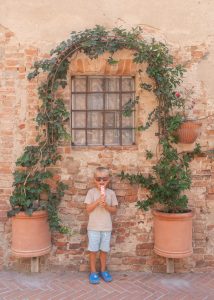
When I think about Dutch lessons for children in Italy, I immediately picture Tuscany.
Cypress trees, rolling hills, little Italian villages and, of course, plenty of sunshine.
And I can completely understand Dutch families who, at some point in their lives, think:
Shall we just do it? Shall we move to Italy?
Over the past thirteen years, we have taught many children at Dutch for Kids whose Dutch parents did exactly that.
Some families live among the hills of Tuscany, others near Florence, Siena, Rome, Milan or Venice.
Their children attend an international or Italian school, make friends, learn Italian and often English as well, and build their lives there.
But after a while, many parents start wondering the same thing:
How do we make sure Dutch remains a strong language too?
Not just a language their child speaks at home with Mum or Dad.
But a language in which they can read, write, learn, tell stories and perhaps, one day, even study.
And that is exactly where Dutch for Kids can help.
From an international school in Siena to Dutch at pre-university level
One family that immediately comes to mind is that of Max and Lucas.
When I first met them, they were around six and eight years old. They lived in Italy and attended an international school in Siena.
Their parents felt it was important for them to develop their Dutch alongside their international education.
Not because they already had plans to move back to the Netherlands.
They simply didn’t want to rule out that possibility for the future.
Perhaps the boys would one day go to school in the Netherlands.
Perhaps they would want to study there.
Or perhaps they would simply stay in Italy.
At that point, nobody knew.
But their parents did know one thing:
If that opportunity arises later, we don’t want the Dutch language to stand in their way.
Their mother originally found me through Google. We arranged an introductory meeting, immediately got along well, and the boys started their Dutch lessons.
What followed was quite a journey.
I ended up teaching Max and Lucas Dutch for more than ten years.
I watched them grow from two young primary-school boys into young adults who completed Dutch all the way up to 6 vwo level – the highest pre-university level in the Dutch secondary school system – before going on to university.
And I still think that is incredibly special.
Maintaining Dutch while growing up in Italy
Because maintaining Dutch when you live in Italy doesn’t happen automatically.
Perhaps you speak Dutch at home.
That is a wonderful foundation.
But most of your child’s daily life takes place in another language.
At an Italian school, your child hears Italian all day. At an international school, English is often the main language of instruction. Friends may speak Italian or English.
And Dutch?
Dutch might be the language Mum uses to ask:
Have you packed your school bag yet?
Or:
What would you like for dinner?
Your child understands everything.
And perhaps they speak Dutch perfectly well at home too.
But that doesn’t automatically mean they can read, write and learn in Dutch at the same level as children of the same age in the Netherlands.
That difference often becomes more noticeable as children get older.
At school, children need to understand increasingly complex texts, explain and support their opinions, write stories and reports, apply spelling rules and develop a much broader academic vocabulary.
So if you want to keep the possibility of going to school or university in the Netherlands open, speaking Dutch at home alone may not always be enough.
A Dutch family near Florence – and a very special recommendation
The story of Max and Lucas recently came back to me in the loveliest way.
A new family living near Florence contacted Dutch for Kids.
They had met another Dutch family on a plane and started talking.
And, completely by coincidence, that other family turned out to be Max and Lucas’s family.
They told them about all those years of Dutch lessons at Dutch for Kids and recommended us.
Their message was essentially:
You should do this for your child. It means they won’t just keep speaking Dutch, but will also learn to read and write it properly. And if they ever want to move to the Netherlands, go to school there or study there, they’ll be able to keep up.
And now this new family has started lessons with us too.
I absolutely love that.
A family who originally found me through Google more than ten years ago is now telling another Dutch family in Italy:
You should have a look at Dutch for Kids.
It feels like the circle has come full circle.
Dutch lessons in Tuscany, Florence, Siena, Rome, Milan or Venice
Of course, our students don’t all live in the same part of Italy.
Because our Dutch lessons are online and one-to-one, children can join us from anywhere in the country.
Over the years, we have taught children living in and around Tuscany, Florence, Siena and Venice, but your child can just as easily join from Rome, Milan, Bologna, Naples, Turin or a tiny village somewhere in the Italian countryside.
You don’t need a Dutch school nearby.
Your child simply opens Google Meet at home and meets their regular Dutch teacher online each week.
And because the lessons are one-to-one, we can tailor them very closely to what each individual child needs.
Sofia and Nicolo: the same family, but very different lessons
Sofia and Nicolo are a lovely example of this.
They lived near Venice, and I taught them for many years as well.
At first, they had lessons together.
Their Dutch levels were quite similar at the time, so that worked well.
As they got older, however, the age difference became more noticeable and they each developed their own strengths and challenges in Dutch.
Eventually, we decided to teach them separately.
And that also made it very clear just how different two children can be.
Nicolo, for example, loved speaking.
With him, I could spend lots of time talking, telling stories, asking questions, actively using new vocabulary and having conversations.
Sofia really enjoyed writing and spelling.
So with her, we could explore those areas in much more depth.
Of course, we make sure children receive a broad Dutch education. Depending on their age and level, we work on reading comprehension, spelling, vocabulary, grammar, speaking and writing.
But one-to-one teaching doesn’t mean that every child has to work through exactly the same list of exercises.
Quite the opposite.
I want to know:
What does this child enjoy? What is challenging for them? And what do they need right now to take the next step?
Dutch lessons tailored to your child
That remains one of the most important principles at Dutch for Kids.
No two children are the same.
One eight-year-old may have lived in Italy their entire life and speak fluent Dutch at home, but never have learned Dutch spelling.
Another child may understand Dutch perfectly but almost always answer in Italian or English.
Another may happily read Dutch books but struggle with reading comprehension and academic vocabulary.
And then there are children who lived in the Netherlands for several years before moving to Italy with their family. For them, the goal may be to keep their Dutch at the same level as children attending school in the Netherlands.
That is why we always start by looking at the individual child.
What can your child already do?
Which languages do they speak at home and at school?
Have they previously received Dutch education?
How are their speaking, reading and writing skills?
And perhaps most importantly:
What would you like your child to achieve in Dutch?
What does your child learn during online Dutch lessons?
Depending on your child’s age, level and goals, our online Dutch lessons can focus on:
- speaking Dutch and forming longer sentences;
- expanding Dutch vocabulary;
- pronunciation;
- reading;
- reading comprehension;
- spelling;
- grammar;
- writing;
- Dutch academic and school vocabulary;
- preparing for Dutch primary education;
- Dutch at secondary-school level;
- and eventually Dutch all the way up to 6 vwo level.
For younger children, lessons can be much more playful, with plenty of speaking, new words, reading and language games.
For older primary-school children, spelling, grammar, reading comprehension and writing gradually become more important.
And with secondary-school students, we can work towards the level they need to maintain a strong connection with Dutch education.
This means Dutch for Kids can continue to grow alongside your child for many years.
Attending an international school in Italy while maintaining Dutch
Many Dutch children living in Italy attend an international school.
That can be a wonderful experience. Children grow up surrounded by different languages, meet classmates from all over the world and often receive their education in English.
But when Dutch isn’t the language of instruction, some aspects of the language don’t develop automatically.
A child may be able to chat away happily with their grandparents in Dutch but still struggle with a Dutch reading-comprehension text aimed at their age group.
Or they may speak beautiful Dutch but have no idea why certain words are spelled the way they are.
And that makes perfect sense.
These aren’t things you automatically learn during conversations around the dinner table.
That is why our lessons help children develop Dutch not only as a home language, but as a language for learning and education too.
What if we move back to the Netherlands later?
This is a question we often hear from Dutch families living in Italy.
Some parents already know their stay in Italy is temporary.
Others have absolutely no idea.
Perhaps you’ll be back in the Netherlands in two years.
Perhaps in ten.
Perhaps never.
And you don’t have to decide that now.
What I have seen over all these years is how valuable it is for children when Dutch remains a language in which they can function at different levels.
Perhaps your child will move to the Netherlands towards the end of primary school.
Perhaps they will attend secondary school there.
Or perhaps they will spend their entire childhood among the Tuscan hills and the Netherlands won’t become relevant until it is time to choose a university.
If that happens, it is wonderful when your child doesn’t suddenly have to start building their Dutch academic language from scratch.
Studying in the Netherlands after growing up in Italy
For Max and Lucas, this was always an important part of the reason for continuing their Dutch lessons.
They didn’t necessarily have to study in the Netherlands.
But they needed to have the choice.
And I think that distinction is important.
Teaching your child Dutch doesn’t mean you have to decide today where they will live in five, ten or fifteen years.
You’re actually giving them more options.
Because studying in the Netherlands requires more than being able to have a nice conversation in Dutch.
You need to understand longer and more complex texts.
You need to be able to write.
You need to understand instructions.
You need to formulate and support an opinion.
And you need a much broader vocabulary than the Dutch you use in everyday family life.
These are all skills we can develop step by step.
Italian, English AND Dutch
And meanwhile, Italian can of course remain an incredibly important language in your child’s life.
As can English, particularly if they attend an international school.
It doesn’t have to become a competition between languages.
Quite the opposite.
How wonderful is it if your child can chat effortlessly with Italian friends, follow an international education in English and talk to family in the Netherlands, read Dutch books and perhaps one day attend school or university there?
Growing up multilingual is something very special.
Our aim isn’t to push Italian or English into the background.
We simply want to make sure that Dutch can remain a fully developed language for your child too.
Not just Mum’s or Dad’s language.
Not just the language of grandparents in the Netherlands.
But a language in which your child can think:
I can do this too.
Thirteen years of teaching Dutch to children around the world
Dutch for Kids has now been teaching Dutch to children and multilingual families around the world for thirteen years.
Over the years, we have had the pleasure of working with many different families in Italy.
Some of those children still live there today.
Some families have since moved back to the Netherlands.
And others left Italy for yet another country.
That is simply part of life for many international families.
Countries change.
Schools change.
Friends change.
And that is exactly why it can be so nice to have something that doesn’t change.
That familiar Dutch lesson every week.
The same teacher.
The same language.
And the feeling:
There is a place for me in the Netherlands too.
Maybe now.
Maybe when I start secondary school.
Maybe when I go to university.
Or perhaps much later.
But the possibility is there.
Free introduction to Dutch for Kids
Do you live in Italy and want your child to continue speaking, reading and writing Dutch confidently?
Does your child attend an Italian or international school, and although you speak Dutch at home, would you also like them to work on skills such as spelling, vocabulary, reading comprehension or writing?
Or would you simply like to keep the possibility open for your child to move to the Netherlands or study there in the future?
We would be happy to talk to you.
During a free introductory meeting, we’d love to hear your family’s story.
Where in Italy do you live? Which languages does your child speak? What kind of school do they attend? What can they already do in Dutch? And what would you like them to achieve over the coming years?
Afterwards, we can arrange a free trial lesson with a teacher who is a good match for your child.
Because whether your child lives among the cypress trees of Tuscany, in the middle of Florence, near Venice or anywhere else in Italy:
Dutch can remain a language in which your child feels at home – while keeping all their options for the future open.