
Parents’ experiences with Dutch for Kids: personal stories from around the world

Marco, Japan 
Christel, Gambia 
Angela, USA 
Carlotta, Itayl 
Mark and Moji, Nigeria 
Ebru, Turkey


Maybe you’ve found your way here because you’ve been asking yourself the same question for a while.
“Are we doing enough to help our child with their Dutch?”
Maybe your family lives abroad and you notice your child’s Dutch slowly slipping. Maybe you’re moving to the Netherlands soon and wondering how your child will cope at school. Or maybe you already live there, and your child understands a lot but still feels nervous about speaking.
Whatever your situation, there’s one sentence I hear from parents almost every week:
“We just want our child to feel confident.”
That’s what it’s all about. That your child can chat with grandma and grandpa. That they dare to make friends and understand their teacher. That school becomes more enjoyable. And that they feel at home, wherever in the world your family lives.
Behind every story on this page is a family who once had exactly the same doubts you may have now. That’s what makes this page so special to me. These aren’t my words, but the experiences of parents who have been where you are.
Two kinds of families
No two children are the same. Still, I see roughly two kinds of families who choose Dutch for Kids.
Families living abroad
You live in Singapore, South Africa, the United States, Spain or somewhere else in the world. At home you speak Dutch, but at school everything happens in another language.
At first, our children hated the idea of Dutch lessons. Now they actually enjoy them!
Christel, Gambia
You want your child to keep speaking Dutch with grandma and grandpa. Maybe because you’d like to move back to the Netherlands one day. Maybe because your Dutch roots matter to you. Or simply because Dutch is part of your family.
Some children start with their very first words. Others work on spelling, reading comprehension or writing. Every child starts where they are right now.
Families living in the Netherlands or Belgium
You moved to the Netherlands or Belgium for work or study. Your child attends a Dutch or Flemish school, an international school or a newcomer class.
That school year, her lessons with Dutch for Kids were really the only thing that got her through.
Angela, mother of Violet, Belgium
For these children, Dutch is much more than a school subject. They want to make friends, introduce themselves, understand their teacher and join in during PE. They want to read a book or give a presentation with confidence.
That’s exactly when personal guidance makes a big difference.
No standard lessons, but a personal approach
The personal attention and tailor-made lessons really make the difference.
Marco, Japan
I don’t believe in one-size-fits-all programmes. That’s why it always starts with a free introductory meeting. Together we look at where your child is, what they enjoy, what’s already going well and what’s still difficult. And perhaps most importantly: what do you hope your child will be able to do a few months from now?
After that, your child gets a free trial lesson with a teacher who suits them.
Is your son crazy about football? Does your daughter love horses, dancing or drawing? Is your child a fan of Minecraft, robots or cooking? Those interests come back in the lessons. Children simply learn much more easily when a lesson connects to their own world.
That’s why every online Dutch lesson for children is tailored to your child’s level, age, interests and goals. It makes learning more effective, but above all more fun.
More than thirteen years
Two years later, both our children were admitted to fully Dutch-speaking schools in the Netherlands.
Moji, from Nigeria to The Hague
When I started Dutch for Kids in 2013, I had one goal: to help children learn Dutch in a personal way.
Today I work with a team of qualified teachers who are native Dutch speakers. Every week, they teach children in every corner of the world, each child with their own dedicated teacher.
Some students stay for a few months. Others for years. I see children who start with their first words and later walk confidently into a Dutch school. Children who barely dared to speak and now happily chat with grandma and grandpa. And students who once took online lessons from abroad and are now at a Dutch secondary school or university.
That’s still the most rewarding part of my work.
The best compliments come from parents
I could tell you how good the lessons are. But parents’ experiences say so much more.
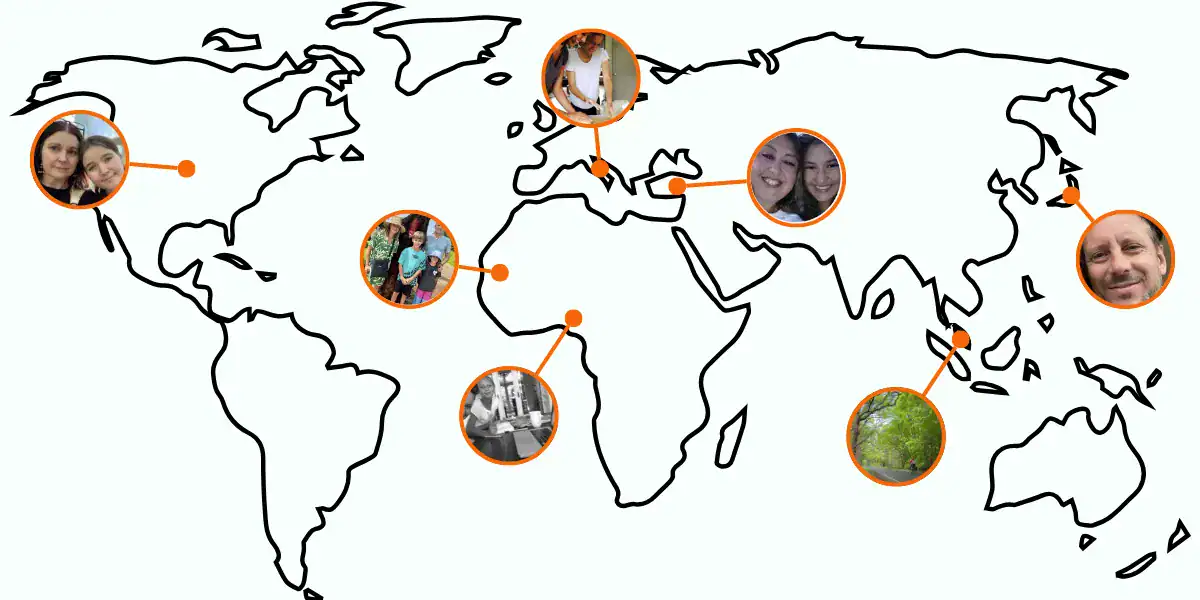
Below, seven families share how they experienced Dutch for Kids. Click through to the full story that’s closest to your own situation.
Families living abroad
Marco, Japan
Marco’s children live in Japan and have never attended a Dutch school. At home they speak Dutch with their father, video call family and watch Dutch films. Still, something was missing: structure.

Christel, Gambia
Christel’s seven-year-old daughter didn’t speak any Dutch yet, and her ten-year-old son was stuck at a low level. Both hated the idea of Dutch lessons. Now they look forward to them.

Max, Malaysia
Max grew up with a Dutch father and an English-speaking mother, and attended an international school. Reading and writing in Dutch didn’t come easily. Years later, he passed the admission test for a Dutch university.

Families living in the Netherlands or Belgium
Violet, from America to a Flemish school
Violet moved from America to Belgium in the middle of the pandemic and ended up at a Flemish primary school, with hardly any language support. Five years later, she has her primary school diploma, and people recently mistook her for a Dutch girl.

Carlotta, from Italy to culinary school
Carlotta came to the Netherlands at fifteen, without speaking the language. She had one dream: to become a chef. Two years later she was accepted into culinary school, and came to my house to make gnocchi.

Moji and Mark, from Nigeria to a Dutch school
Moji and Mark knew two years ahead that they’d be moving to the Netherlands, and they used that time. Their children learned Dutch online from Nigeria and later both went on to a bilingual grammar school.

Ebru, an international school in The Hague
Ebru’s daughter attends an international school and wasn’t keen on Dutch at first. Until the lessons connected to her own dream: studying at TU Delft. Now she finishes her Dutch homework before she even starts her regular schoolwork.

My own story: how Dutch for Kids began
When I was a child, my family lived on Aruba for a while because of my father’s work. A wonderful family adventure.
Because our stay was only temporary, I couldn’t simply go to a Dutch school. Luckily, we were taught by a Dutch teacher on the island, using textbooks from the Netherlands. That kept my Dutch at the right level.
So I know from experience how special it is to grow up abroad. An adventure full of new memories, beautiful places and precious moments with your family. But I also know it isn’t always easy.

Sometimes friends from the Netherlands would call to tell me about a party, and I’d feel sad that I couldn’t be there. Then my mum would say: “Did you tell them you were at the beach this morning?”
And I’d think: yes, that’s actually pretty special too.
Because I know how wonderful and how challenging life abroad can be, it has always been my mission to help children with their Dutch. After years of working as a primary school teacher, that’s why I started Dutch for Kids.
And every day I still feel lucky that I get to help children all over the world with their language.
Anouk, primary school teacher and founder of Dutch for Kids
Curious what Dutch for Kids could mean for your family?
Do you recognise yourself in one of these stories? Maybe you live abroad and want your child’s Dutch to stay strong. Maybe you’re moving to the Netherlands soon. Or maybe you already live there and your child could use some extra support to feel more confident at school.
She has become much more motivated, and now she even makes sure she finishes her Dutch lessons before her regular schoolwork.
Ebru, The Hague
Then book a free introductory meeting. Together we’ll look at where your child is now and what you’re hoping for. After that, your child gets a free trial lesson with a teacher who suits them. That way you’ll find out, without any obligation, whether this approach fits your family.